

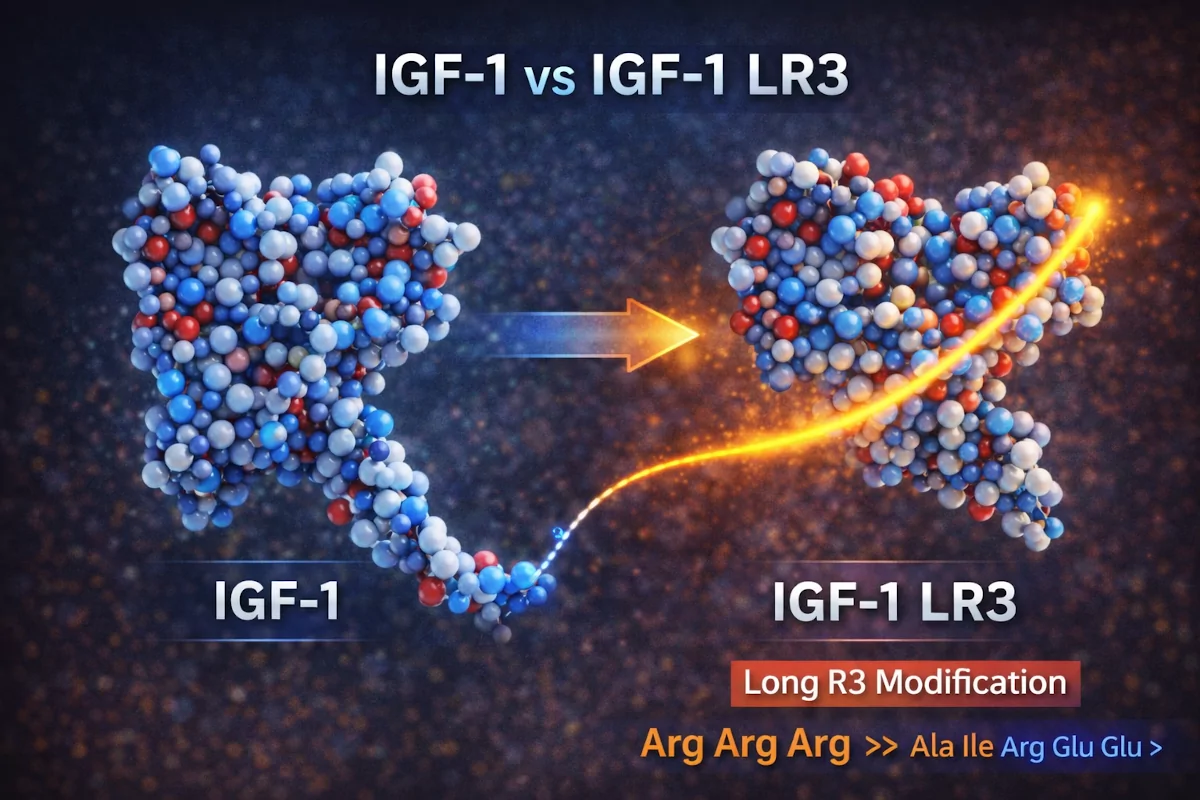
What if you could move beyond simply enlarging existing muscle cells and instead stimulate the creation of entirely new ones? What if you could directly command nutrients to flood into your muscles and accelerate repair at the cellular level? This isn’t science fiction—it’s the proposed mechanism of Insulin-like Growth Factor-1 Long R3, better known as IGF-1 LR3.
More than just another peptide in the fitness arsenal, IGF-1 LR3 represents a fascinating frontier: the direct application of a biologically engineered growth factor. This guide will demystify the complex science behind it, separate the substantiated benefits from the theoretical hype, and provide a responsible framework for understanding its potent effects and significant risks. To understand how it fits into the broader peptide landscape, explore our overview in Beyond Steroids: How Peptides Are Revolutionizing Fitness and Recovery.
What Exactly is IGF-1 LR3? The “LR3” Difference Explained
Natural IGF-1 is a key hormone produced primarily in the liver in response to Growth Hormone (GH). It’s a primary mediator of GH’s effects, promoting growth and regeneration in muscle, bone, and other tissues. However, its natural form has limitations: a very short half-life and high binding affinity to proteins in the blood that render it inactive.
IGF-1 LR3 is a synthetically modified, supercharged version designed to overcome these limitations:
1. The “Long” Modification
13 extra amino acids are added, making the molecule resistant to degradation. This extends its active half-life from minutes to 20-30 hours, allowing for once-daily administration.
2. The “R3” Substitution
A crucial amino acid swap (Arginine at position 3) dramatically reduces its binding to IGFBP (Binding Proteins). Since over 99% of natural IGF-1 is bound and inactive, this means a far greater percentage of LR3 remains “free” and biologically active.
Simple Analogy: If natural IGF-1 is a skilled worker with a short contract, IGF-1 LR3 is the same worker with a longer contract, protection from being sidelined, and a megaphone to get more done.
The Dual Mechanism: How IGF-1 LR3 Works in the Body
1. Potent Nutrient Shuttling (The “Pump” Effect)
As “Insulin-like” suggests, LR3 mimics insulin but with a stronger preference for muscle tissue. It dramatically increases the transport of glucose and amino acids into muscle cells, creating a profoundly anabolic, glycogen-supercompensated state. This results in the legendary perpetual muscle fullness, extreme pumps, and vascularity users report.
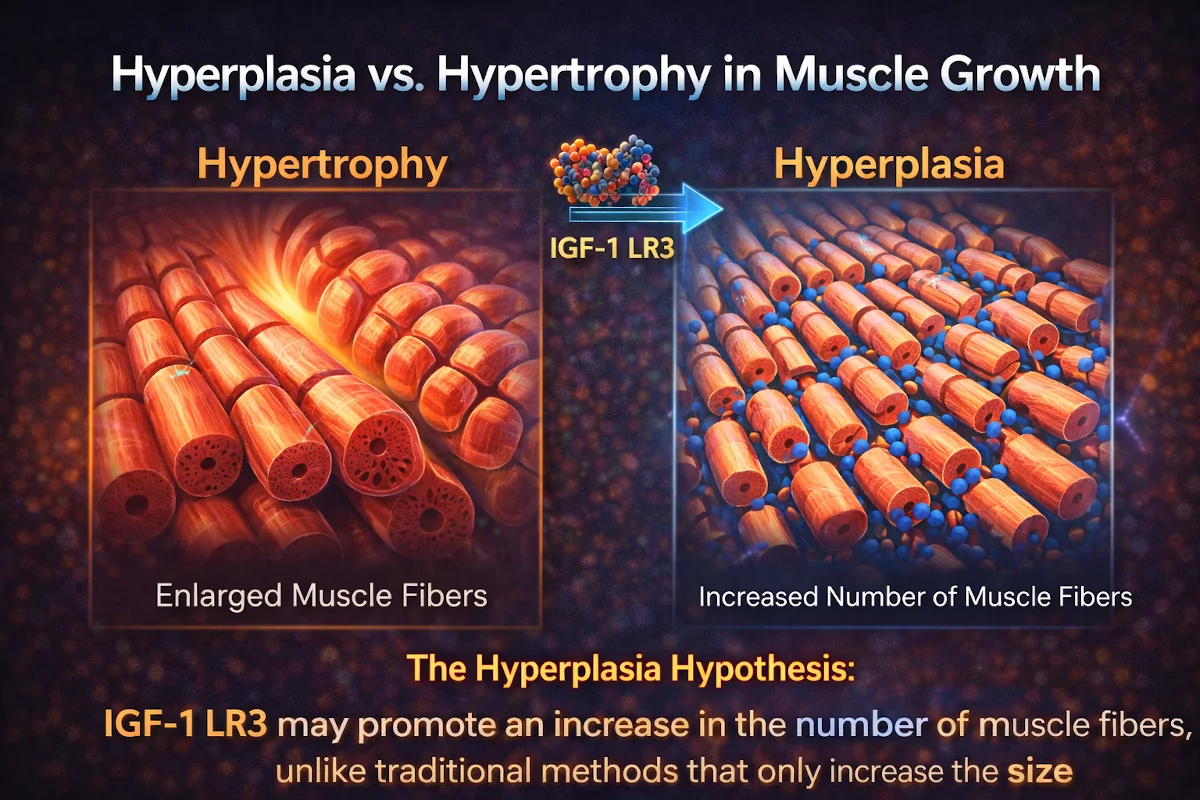
2. The Hyperplasia Hypothesis (The “New Cells” Potential)
This is the most compelling and debated aspect. While traditional steroids and training promote hypertrophy (enlarging existing muscle cells), research suggests IGF-1 can stimulate hyperplasia—the activation and differentiation of satellite cells to create entirely new muscle fibers.
Animal and cellular studies strongly support this mechanism. While large-scale, conclusive human trials are limited, the theoretical rationale is sound: LR3 provides a direct, powerful signal for cellular proliferation and growth at the most fundamental level.
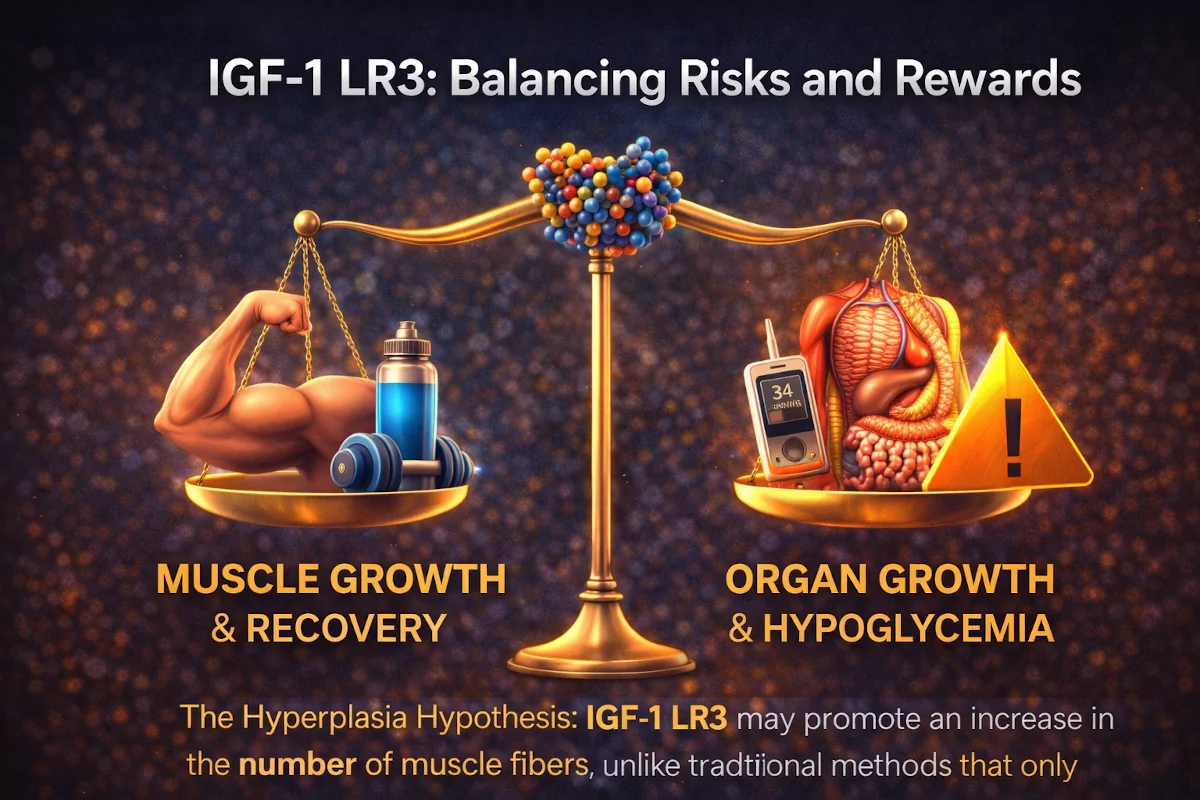
⚠️ Critical Risk: Hypoglycemia is Your #1 Immediate Concern
Its potent insulin-mimicking action can cause dangerous drops in blood sugar (hypoglycemia). Symptoms include shakiness, dizziness, sweating, confusion, and in severe cases, loss of consciousness. NEVER administer IGF-1 LR3 in a fasted state. Always consume 30-50g of simple and complex carbohydrates around your injection time.
Realistic Benefits & Effects: What Can You Actually Expect?
| Proven & Noticeable Effects | Theoretical/Long-Term Potential |
|---|---|
| Extreme Muscle Fullness & Pumps: Unmatched vascularity and a constant “pump” from nutrient shuttling. | Muscle Hyperplasia: The potential addition of new muscle cells, leading to more durable, “harder” quality muscle over multiple cycles. |
| Dramatically Enhanced Recovery: Significant reduction in DOMS (muscle soreness) and faster turnaround between workouts due to direct cellular repair. | Synergistic “Frame Building”: The concept of using LR3 to create new cellular “frames” (hyperplasia) that can then be filled out with traditional AAS (hypertrophy) in a stack. |
| Increased Protein Synthesis: Creates a highly anabolic, anti-catabolic internal environment. | Improved Nutrient Partitioning: Over time, may enhance insulin sensitivity, directing more calories toward muscle instead of fat. |
The Practical Protocol: Dosing, Timing, and Administration
Critical Note: IGF-1 LR3 is dosed in micrograms (mcg), not milligrams. Mistaking this can lead to a dangerous overdose.
Beginner / General Enhancement Protocol
Dose: 20-40 mcg per day.
Timing: Post-workout for intramuscular (IM) injection into trained muscles, or morning for systemic subcutaneous (SubQ) use.
Cycle: 4 weeks on, 4-6 weeks off.
Intermediate / Performance Protocol
Dose: 40-80 mcg per day.
Timing: Post-workout IM injection is preferred for site-specific effects.
Cycle: 5-6 weeks on, 6 weeks off.
Note: Always consume carbs with or immediately after injection.
Site Enhancement / Lagging Muscle Protocol
Method: IM injection directly into the lagging muscle group immediately after training it.
Rationale: To concentrate the growth factor’s effects on a specific area. Rotate injection sites carefully to avoid excessive local tissue growth or irritation.
Serious Risks and Non-Negotiable Considerations
Beyond hypoglycemia, the potency of IGF-1 LR3 demands respect for these significant risks:
- Organ Growth (Visceromegaly): IGF-1 promotes growth in all tissues. Prolonged, high-dose use can lead to enlarged internal organs (kidneys, liver, heart), a serious and potentially life-threatening condition.
- Acromegaly-Like Symptoms: Unchecked use may cause bone growth in the jaw, hands, and feet, along with coarsening of facial features—effects similar to the disease acromegaly caused by excess GH/IGF-1.
- Theoretical Cancer Risk: As a potent growth factor, it could potentially accelerate the proliferation of existing, undiagnosed cancerous or pre-cancerous cells. It is absolutely contraindicated for anyone with a personal or strong family history of cancer.
- Other Side Effects: Water retention, numbness or tingling (from potential nerve growth), headaches, and increased fatigue.
For recovery from specific injuries rather than systemic growth, other peptides may be more appropriate. Learn about a focused healing compound in our guide How Peptides Like TB-500 Support Full-Body Recovery and Regeneration.
What Results to Expect: A Realistic Timeline
- Weeks 1-2: Noticeable and extreme muscle pumps during/after workouts, improved recovery, increased hunger. Muscles appear fuller and more vascular.
- Weeks 3-6: Significant improvements in muscle density and hardness. The “full” look becomes more constant. Strength may increase due to improved recovery and neural efficiency.
- Long-Term (Multiple Cycles): The purported benefit—adding durable, “harder” muscle that appears more dense and full even off-cycle, which users attribute to structural changes from hyperplasia.
Conclusion: A Specialist’s Tool, Not a Beginner’s Shortcut
IGF-1 LR3 is arguably the most potent direct growth factor accessible in the performance enhancement world. Its unique potential to influence muscle at the cellular level separates it from steroids, SARMs, and GH-secretagogues. However, its power is a double-edged sword. The risks of hypoglycemia and systemic organ growth are not theoretical—they are immediate and serious.
This compound is not for those new to PEDs. It is a specialist’s tool for advanced individuals who have mastered training, nutrition, basic supplementation, and have a thorough understanding of health monitoring through bloodwork. It demands meticulous protocol management, respect for its mechanism, and a primary focus on safety over rapid gains. Brands like Dragon Pharma offer it, but the user’s knowledge and caution are the most critical components of any cycle.
Note: The information in this guide is synthesized from scientific literature on IGF-1 mechanisms, preclinical studies, and established harm-reduction practices. It is for educational purposes only. IGF-1 LR3 is typically sold as a research chemical and is not approved for human use. The legal status of possessing or using it varies by country and region.
